

We're used to garden-variety frost and ice this time of year. Starry winter nights often lead to slippery winter mornings.
Frost is familiar; it occurs on cold, clear nights, forming when water vapor freezes into ice crystals, coating plants and lawns with a sparkly sheen by sunrise. However, frost has nothing on the wondrous tendrils of delicate "hair ice," which requires even more specific conditions.
What is hair ice, you ask? It's not just frozen water...
This fragile and ephemeral feature requires rotten hardwoods, especially red alder and bigleaf maple; high humidity; and temperatures just below freezing in windless conditions.
Our ACFL has plenty of alders and maples. As branches of these trees fall to the ground and rot, the winter-active fungus Exidiopsis effusa may grow within the wood. As it "breathes" and releases air and spores at night, it pushes out moisture from the pores within the wood.
When that moisture reaches the wood's surface and hits the cold air, it freezes instantly. Like thin lines of toothpaste squeezed out of a tube, the strands grow longer and longer. The more moisture that is pushed out, the more strands of hair ice appear, each one five times thinner than a human hair. Touch the gossamer strands and you’ll find they feel as if the strength of the wood has been transformed into ice.
Hair ice is so whimsically magical, so unexpected and exquisitely fragile, a perfectly coiffed beard of fine white threads radiating from dead wood. And so easy to overlook. It melts quickly in sunlight or as temperatures rise above freezing, but can regrow year after year on the same branch as long as the fungus remains.
I first saw it last winter on a cold morning while hiking near Whistle Lake.
With temperatures dipping to 28 degrees this week and nights perfectly still, I wondered if I might find it again. After a Sunday breakfast of blueberry pancakes and fried eggs (mmmm), I arrived at the Whistle Lake parking lot. The sun had yet to rise over the ridge. I bundled up — sweater, puffy vest, puffy coat, stocking cap, gloves. I’m such a wimp starting out.
Walking the lake’s west-side trail, my gloves came off to take pictures. The rocky island wore a white frosting. A skim of ice covered the waters west of the island. Not a breath of wind stirred.
Climbing the hill west of the lake, I shed my coat as beads of sweat broke out. Sunlight began peeking through the trees. I walked on.
And then, there it was.
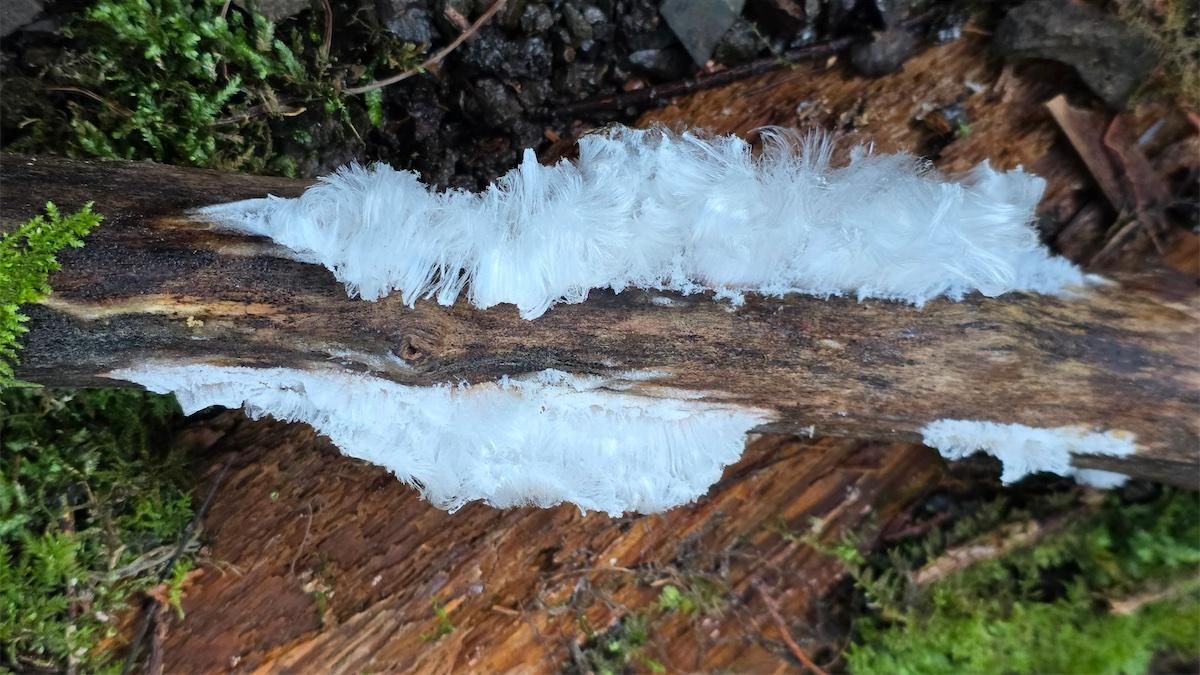
A maple stick lying on the side of the trail, crowned with a hefty scalp of microfine hair. Farther along, near a stream that parallels the trail, two broken branches sported this winter’s newest hairstyles. It was hair again!
I knelt in the muddy leaves and duff to get up close, careful not breathe on the delicate tresses. The sun began to slip into this alder grove, and I knew the magical manes would soon be gone.
A touch of sunshine or warm breath — and its gone.
And so with my full belly, a grateful heart, and a joyful love, I had left the breakfast table and hiked to an ephemeral miracle of freezing water and living mycelium growing a mullet of bright white hair overnight for no apparent purpose other than to create a mesmerizing sight for those who kneel in the forest to marvel at its beauty.
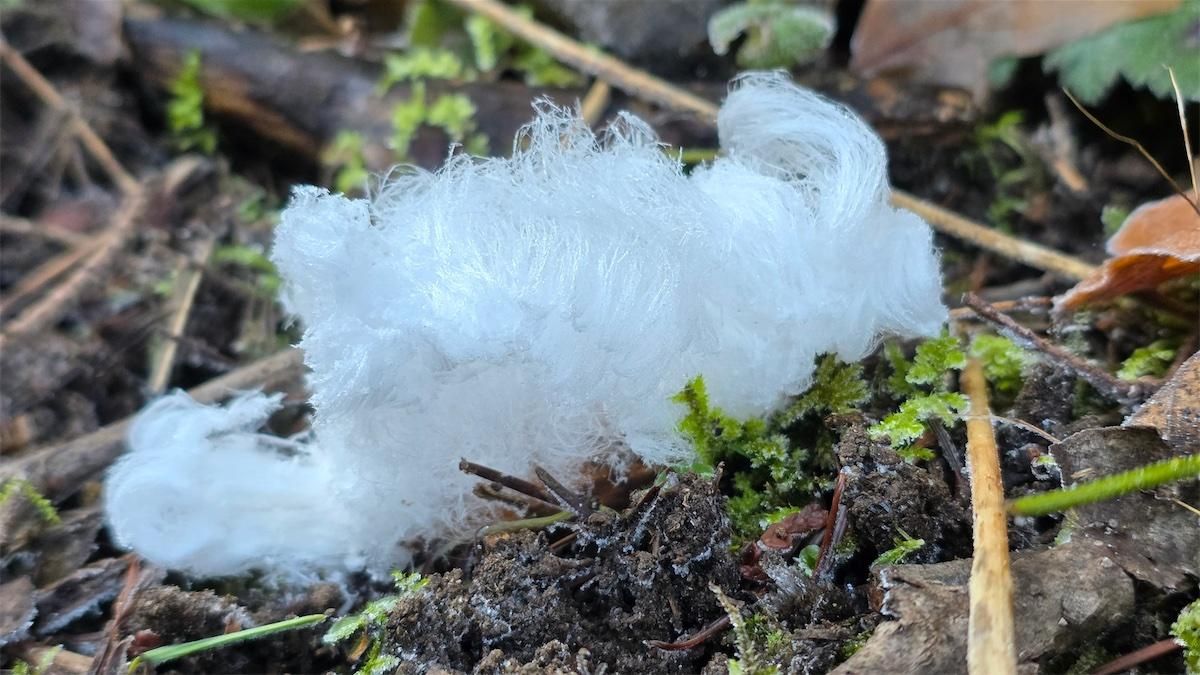
Walking back, the sun filled the skies and mirrored off the lake in golden beauty. And there was one last small branch, right beside Trail 20, passed and probably unseen by dozens of people already this day.
Later that day, I talked at length with one of my boys, then with a friend downtown, sharing openly and lovingly about positive changes in our lives. I felt so uplifted. And the Seahawks won. But that night we read an email from a dear friend facing a terminal disease. And so it goes.
Today, Kath and I sit at our dining room table, eating our cereal and looking out at Fidalgo Bay glowing peacefully in the rising sun, the waters pancake-flat. We give thanks for what we have. We are relatively healthy. We have food, a good home, freedom from most dangers, and no masked agents at our doors or in our streets acting on the whims of a lawless dictator. But we also know that Ukrainians felt quite safe four years ago, and Greenlanders had no worries four months ago. Things can change in a heartbeat, figuratively and literally. And we know that all of our lives melt away in the end.
That is the meaning of life, is it not? That it ends.
Take no one for granted today. Look for the goodness and wonder all around us, even in a bit of hair ice.
Me at Whistle Lake, with bed-hair
Additional Sources:
The Street Smart Naturalist, David B. Williams
Shannon O’Donnell, Chief Meteorologist, KOMO News, Seattle
And many others
One more detail:
Interestingly, the scientist who first studied hair ice was Alfred Wegener, proposing in 1918 the fungus and hair ice connection. Wegener is best known for his theory of continental drift. Like his theory on hair ice, decades would pass before scientists proved he was correct about how the Earth’s land masses once formed a single great continent.
Republished with permission. Read the original article.