

photo: Anacortes American founder Douglass Allmond, at right, and 1950s-60s publisher/photographer Wallie Funk seem to be heading out to cover news stories in these murals at the Anacortes American building on Sixth and Q. (Richard Arlin Walker, 2020)
By Richard Arlin Walker, Salish Current
Anacortes American’s home for 109 years sold to nonmedia owners
Elegant in its youth, humble in its advanced age, the Anacortes American building has outlived many of the industries covered by the early editions produced within its walls.
No other building in Anacortes has been owned and occupied by the same business for as long. The salmon canneries? All but Trident are gone. The railroad? Gone. The mills? Gone. Other newspapers have come and gone as well.
The Anacortes American building at Sixth Street and Q Avenue — occupied by the same newspaper that commissioned its construction — outlived them all, a symbol of continuity in an ever-changing community.
Until now. For the first time in its 109-year history, the building is owned by a nonnewspaper company.
Adams MultiMedia — owner of the Anacortes American, Skagit Valley Herald and more than 140 other newspapers and magazines in the U.S. — sold the building to Downtown Anacortes boosters Ward and Christina MacKenzie and Kathleen Dickinson. The sale closed on Aug. 8, according to records on the Skagit County Assessor’s website. The closing price: $750,000.
The new owners say they plan to restore the building, which now has three business tenants. The Anacortes American has an office here, as does the Downtown Anacortes Alliance, a business association founded by the MacKenzies and Dickinson. The old press room is being used as a pop-up holiday store by The Predecessors, a seller of vintage furniture and décor.
Among the restoration work to be performed: exterior concrete wall repair, exterior and interior painting, and installation of an interior ventilation system. The dank basement, once a plant for the casting of metal type for the printing press, will be dried out and the walls sealed and painted.
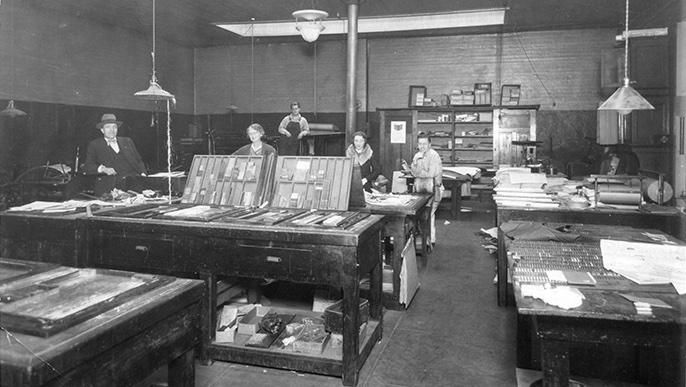
photo: Anacortes American publisher J.M. Post stands at left in the newspaper’s press room in this circa 1920 photo. Post built the Anacortes American building at Sixth and Q in 1916. (Wallie Funk Collection, Anacortes Museum)
The building’s ties to local newspaper history will be preserved, the owners said. The Bill Mitchell murals of two luminaries from the newspaper’s past — founder Douglass Allmond and publisher/photographer/columnist Wallie Funk — will remain. The large Anacortes American sign will stay, though it may be moved inside to become part of a lobby exhibit on the newspaper and the building’s history.
Christina MacKenzie said the partners envision a trompe-l’œil mural on a vacant exterior wall that would give the viewer the impression of looking at the printing presses in operation in the early 1900s. The tall windows — originally beveled glass — fronting the building along Sixth and Q are part of the original building design and allowed passersby to watch the newspaper operation from typesetting to printing press.
“I like that it has such a history attached to it and that it’s been such an integral part of the community,” Ward MacKenzie said of the building. “We were really glad the newspaper decided to stay. It made good sense because we want tenants that will add to the downtown and are part of its history.”
Dickinson said of the building’s location: “It’s a beautiful corner. The Municipal Building is right here. It’s a block away from The Depot. This is where it all happens.”
Stanching the bleeding
Adams MultiMedia joins a growing number of media companies that have sold newspaper properties as real estate values grow and space needs shrink due to cost-saving consolidations of operations and a shift toward digital media. The Seattle Times and newspaper companies in Boston, Dallas, Miami, San Jose and Washington, D.C., are among those that have sold former newspaper properties to residential and retail developers. Closer to home, McClatchy sold the Bellingham Herald building in 2009 to Bob Hall and David Johnston of Daylight Properties. The building is now occupied by business offices, restaurants, cocktail lounges, and the Western Washington University Alumni Welcome Center.

photo: The Anacortes American’s front page on Aug. 24, 1916, heralded its new building as “the most up-to-date of its class” and “an important event in the newspaper annals of the Northwest … The beauty and completeness of the structure is a credit to contractor L.A. Farmer of this city, who designed and erected it.” (Washington Digital Newspapers)
Salish Current unsuccessfully reached out for comment from Rebecca Poynter, Adams’ regional president and publisher of the Anacortes American and Skagit Valley Herald. There were 13,000 newspapers published in the U.S. and the nation had a population of 62.9 million when the first edition of the Anacortes American was printed in 1890. There are 6,730 newspapers today, while the population is 342 million.
Weekday newspaper circulation first dipped below 1940 numbers in 2013, according to Statista, and in 2018 Sunday circulation numbers first fell below those of 1940.
“I helped launch the American’s first website, which was all free back in those days and was a great driver of circulation numbers for us,” said Duncan Frazier, the American’s editor/publisher from 1994-2001.
“We had a lot of people that were subscribing from afar for a mail subscription because they wanted to get to know the town before they moved here. But once the Internet really took off, we lost classifieds and display advertising for auto and real estate, which was the bread and butter of everything … Once you strip away the advertising revenues, the pressure to downsize is everywhere.”
Printing of the American was moved from Anacortes to Mount Vernon in December 2000. There were six newsroom staffers in 2001; that number dropped to three by 2018 and one today, not including an editor who also oversees the Skagit Valley Herald and the Stanwood-Camano News. The newspaper has a paid circulation of 2,318, according to Adams MultiMedia’s website.
Jacqueline Allison was a reporter at the American from 2017–19 before moving on to daily newspapers and, finally, to her current job as communications specialist for the Association of Washington Business. The American was her first newspaper job after college.
“It’s a great location, across from City Hall, and I always felt proud that we were there literally keeping watch over city government,” Allison said. “I enjoyed spending hours in the archives room, looking at the bound copies of past editions to help with my reporting. While it’s sad to see the physical footprint of the newsroom shrink, it’s heartening to hear that the new owners are committed to restoring the building.”
Carl Funk is glad the building’s new owners are committed to preserving it, because the building helps tell the story about an important aspect of the city’s history. He was 8 in 1964 when his father, Wallie Funk, sold the Anacortes American and bought the Whidbey News-Times. During adulthood, though, the younger Funk would occasionally visit the news office and chat with the editor.
“I can tell you, to this day when I see the picture of my father in the doorway, it’s a meaningful thing for me,” he said. “I believe that building is really part of the history of the city. And that’s what Wallie was all about, preserving the history of that region.”
Frazier, too, is glad the building will be restored and the American’s presence continues. It’s a reminder of the importance of verified and verifiable journalism in a democracy.
“Attention spans have diminished, I think, from what they used to be back in the day,” Frazier said. “Everybody’s got a phone in their hand and that’s their information device now. There’s still something to be said for news gathering. It’s just delivery by newsprint that’s on the way out.”
Anacortes American factoids
“Murder basement”: That’s what some past employees called the basement because it’s dark, dank and, well, kind of spooky. The heating furnace is long gone, but there’s ash in the furnace chimney’s ash box. Also visible are two wall cavities: one, for the chute by which lead type was sent from the press room to the smelter; and another for a dumbwaiter used to send lead ingots up to the press room for the casting of new printing type.
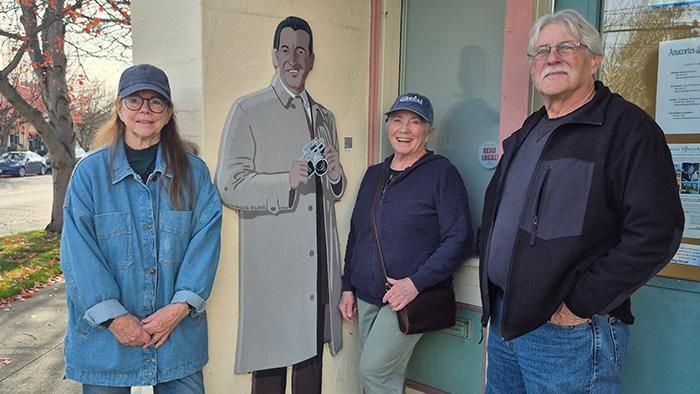
photo: From left, Kathleen Dickinson, Christina MacKenzie and Ward MacKenzie pose next to the Bill Mitchell mural of past Anacortes American publisher Wallie Funk, Nov. 9 in the doorway of the Anacortes American building. Dickinson and the MacKenzies bought the 109-year-old building from Adams MultiMedia. (Richard Arlin Walker photo).
Mystery stain: The space now used for the kitchen was historically part of the press room. And that history didn’t give up easily. “I recall that the new linoleum that they laid over the cement in that room, in the back toward what became the kitchen, there was something that was in the concrete floor that stained through the linoleum,” said Duncan Frazier, editor/publisher of the American from 1994–2001. “The thought was that this was old ink or something that was bleeding up. I don’t know if that’s what it was, but the new linoleum was stained almost instantly.”
Wallie’s darkroom: In the former press room there’s a room with a red light above the door. That’s the darkroom installed by Wallie Funk, owner of the American from 1950–1964. The room is now used for storage, but the sink and countertop used by Funk when developing film and making prints are still there. The light above the door alerted people that the darkroom was being used and to not open the door. There’s also a red safelight inside the darkroom that provided visibility in the dark without exposing the paper or film. Christina MacKenzie refers to the room as Wallie’s darkroom and said it will stay put.
Locations: The American operated at four different sites in Anacortes between 1890 and 1916, when it moved to Sixth and Q.
- 1890–1897: 10th Street and M Avenue. Building destroyed by fire
- 1897–1905: Rooms 1 and 2, Platt Building
- 1905–07: Southeast corner of Commercial Avenue and Eighth Street
- 1907–16: 913 Sixth Street (currently site of Salt & Vine)
- 1916–present: Sixth Street and Q Avenue.
Owners: The American has had 10 owners — some partnerships, some corporate — since its founding.
- 1890–1892: Douglass Allmond and F. H. Boynton
- 1892–1902: Douglass Allmond
- 1902–1904: Frederick Ornes
- 1904–1907: Frank H. Barnett
- 1907–1930: J.M. Post
- 1930–1939: Vernon McKenzie and Carl A. Sandquist
- 1939–1950: Cornelius Root
- 1950–1964: Wallie Funk and John Webber
- 1964–1975: Scripps League
- 1975–2017: Pioneer News Group (spun off from Scripps League)
- 2017–present: Adams MultiMedia
Republished with permission. Read the original article.