
President Obama signed a proclamation March 25 using the Antiquities Act to preserve about 1,000 acres already managed by the Bureau of Land Management. National monument status prevents the small islands, historic sites and north Puget Sound habitat from being sold or developed.
Salazar and Sen. Maria Cantwell joined Reps. Rick Larsen and Suzan DelBene and environmental, tribal and other community leaders for the hour-long celebration. Another celebration was planned Monday afternoon on Lopez Island.
Salazar told the packed Senior Center room that the San Juans will be an economic engine for the region through tourism and outdoor recreation. He said the establishment of the San Juan Islands National Monument, "is one of the crowning things" of his term as Interior Secretary. "People will come to the San Juan Islands and Anacortes because they want to see this great place."
Cantwell thanked the island community for, "a tremendous community spirit to protest the islands."
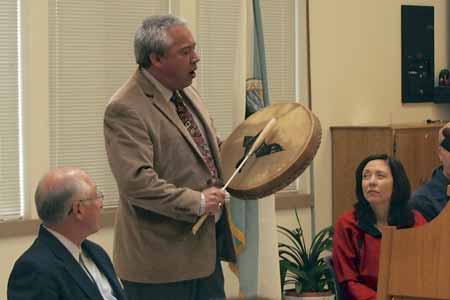 Tom Wooten, chairman of the Samish Tribal Community, sang a song, his family song, during the celebration.
National monument status will permanently protect precious lands in the San Juan Islands. These sites, already managed by the Bureau of Land Management (BLM), include recreational areas beloved by locals and visitors, cultural sites used by local tribes for thousands of years, historic lighthouses, disappearing habitat and much more.
National monument status assigns these lands to BLM's National Conservation Lands, which requires BLM to protect and preserve these lands, directs BLM to work closely with the local community on a management plan, and prevents potential exploitation, development, or sale of these sites.
The Conservation Lands assignment could also have been made by Congress, designating a national conservation area (NCA). Senator Cantwell, Senator Murray, Representative Larsen, and Representative DelBene introduced legislation to do just that in both the 112th and 113th Congress. Congressional gridlock is preventing action on that legislation, so the delegation joined the community in supporting presidential action to accomplish the goal of permanent protection of BLM lands in the San Juan Islands with a strong community voice in their management.
The new National Monument contains a wide array of habitats, with woodlands, grasslands, and wetlands intermixed with rocky balds, bluffs, inter-tidal areas, and sandy beaches. In an area with limited fresh water, two wetlands within the new National Monument are one of the more significant freshwater habitats located on public land in the San Juan Islands. This diversity of habitats is critical to supporting an equally varied collection of wildlife, including black-tail deer, river otter, mink, and an array of birdlife such as the threatened marbled murrelet and the recently reintroduced western bluebird. The island marble butterfly, once thought to be extinct, is found only here. Marine mammals, including orcas, seals, and porpoises, attract a regular stream of wildlife watchers.
Nearly 80,000 visitor days are logged each year at the new National Monument. Visitors are attracted by the outstanding wildlife watching opportunities, as well as the chance to visit historic light stations. Fishing, crabbing, shrimping, and kayaking are also popular, as are hiking and camping, though these latter activities are somewhat limited due to the relatively small size of the parcels composing the new monument. The new National Monument is also used by outdoor and environmental education programs designed to help young people gain first-hand experience in a marine environment.