
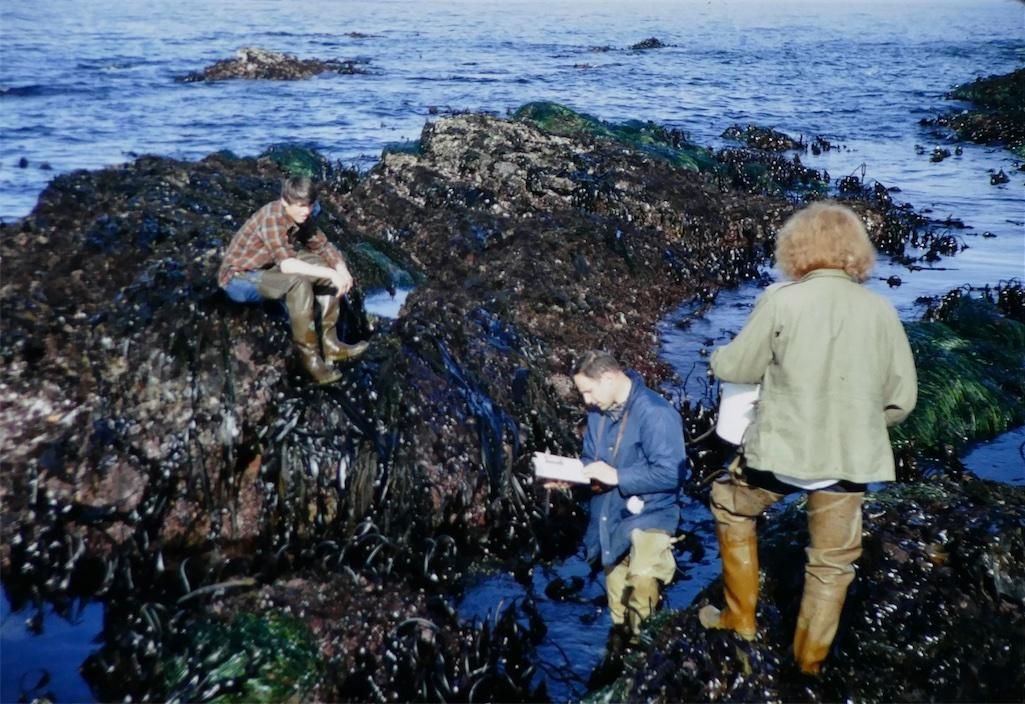
 photo: My high school marine biology teacher, Mr. Quackenbush, looking up a critter at a rocky beach on one of our field trips. Yeah, that's me on the left, sitting on my butt in my hip waders. credit: Jack Hartt.
When I was a teenager, my best friend wanted to be a zookeeper. He raised snakes and frogs in his bedroom, and crickets and other critters to feed them. On a high school field trip to Sucia Island one spring, he and I slipped away at night to find more Pacific chorus frogs for his growing mini-zoo.
Hiking down in our hip boots by flashlight to a freshwater pond, we slipped into the water’s edge and then stood still. He was armed with collecting jars and other gadgets. I had only my ignorant wonder as to what would happen next.
Standing silently under the stars, we waited. Then across the pond, “krek-uk.” Then another, and another, and then a thousand had joined in, some close at hand. I was so overwhelmed by the power of this heavenly choir it brought tears to my eyes. Somehow, my friend found and gathered a couple of the choir members to bring home.
I brought back an unforgettable memory of that majestic nighttime serenade.

photo: Our Fort Worden house in the evening. credit; Jack Hartt.
When my kids were little, we would go down at twilight to a little pond in Fort Worden. As darkness fell, we would all sit quietly (which is an amazing feat for young ones!) and wait. We didn’t have to wait long. First there would be one "ribbit", and our eyes would widen with anticipation. Then another. And another. And before long, a loud choir of chorus frogs would create a symphony of individual voices blending into their raucous song of spring.
If one of us stirred or shifted our legs, the frogs fell silent. They waited. We waited. Once again, one frog would test the airwaves, then another, and soon the full-throated songs were back, caution to the wind.
That magical sound never grows old.
This past sunny Sunday, Kath and Murphy and I boarded the 1 pm Guemes Ferry and walked west on Guemes Island. Our only goal was rest and relaxation, which for Kath and me means strolling the beach hand in hand, no hurry, no deadline, just letting the sand and sea fill our spirits. For Murphy, it means sprinting the shoreline to chase his ball. He tore across the tide-washed beach to catch his ball as it arced down toward the water’s edge, grabbing it in an explosion of flying sand, the ball caught firmly in his teeth.
As we walked past the dreamy beach homes, we imagined what it would be like to live there. Dreams are free.
And then we heard an unforgettable sound. It was faint like a distant memory at first, but as we approached Peach Preserve, it became clear and unmistakable. Pacific chorus frogs. Dozens, no, hundreds, thousands maybe, who can tell? A cacophony of individuals, these little creatures could easily fit in the palm of a child’s hand. And we could hear them a quarter mile away.
Wandering the trails of the preserve, the sounds grew ever louder, ever closer.
We followed the trail that parallels the cattail-filled wetland. I turned to Kath and put my finger to my lips as we neared the midway bench. Silently we stood there. The chorus remained strong throughout the several-acre pond of cattails, except for right at our feet. All was silent near us. We stood motionless. Yes, even Murphy.
Then one "krek-ek" not far away, then another, closer, hesitant, then full-throated. It’s breeding season. And here it was midday, croaking their deep desire, not waiting for the cover of night to invite eligible ladies to dinner, a movie, and a midnight dance.

photo: Listening to the frogs at the Peaches Preserve wetland. credit: Jack Hartt.
The nearest fellow was almost at arm's length from me, unseen amid the dense cattails. The moment lasted forever, or maybe just a few seconds, I don’t know. I shifted a little as I stood there, and his voice stopped. The rest of the frogs continued to fill the afternoon with their symphonic choruses.
Imagine the power of that joy, that longing, that desire, unthrottled and free. Better yet, go find your nearest wetland right now, at twilight usually, and dwell in the din of their joy for a while.
- Ya gotta check out the video! It's five minutes long, with 100 seconds of nothing but pure croaking. Click on this link: https://www.youtube.com/watch?v=o3jz5xlMwVk
We walked to the west end of the meadow, surprising and being surprised by two herons that grawked a complaint as they flew overhead. I climbed a few feet up into a dead tree to get a birds-eye view, but soon thought better of trusting dead branches and dropped back down. Circling back to the beach, mergansers and buffleheads dove into the ebbing tidewaters for their dinners. A lone beachcomber passed us slowly. A young family that had been on the ferry with us lounged on the beach, their young child playing at the water’s edge with his mom keeping a close watch on his adventurous spirit.

Soon we were back at the ferry dock, waiting with others for the ferry’s return. The sound of the chorus frogs had faded with the distance, but not from our memories.
Extra Credit:
Wexes (pronounced Wah’ – haas) – Moon of the Frog (Mid-February to Mid-March) is a significant time in the traditional calendars of the Coast Salish people of the Pacific Northwest. The frog on the moon’s face represents the Keeper of the Sacred Season, the return of spring and the awakening of nature. This moon marks the time when hibernating frogs emerge, signaling that the earth is warming and it is safe to return to the water. The tribes place cedar boughs along the shore to attract herring, which lay their eggs on them —providing a vital food source. This moon also signals the end of winter ceremonial dances and the beginning of outdoor activities, preparing for the return of the salmon.

image: Symbol of Wexes, courtesy of the Samish Indian Nation
The Pacific Chorus Frog can be distinguished from all other frogs within its geographic range by two characteristics: 1) the presence of toepads, and 2) a dark stripe that extends from just before the nostril, through the eye, and past the tympanum (ear). No other frogs found within the geographic range of the Pacific Chorus Frog have both of these characters
Adult Pacific chorus frogs are generally 3.0 to 4.5 cm (1 to 2 inches) long. On average, females are larger than males. During the breeding season, males can be distinguished from females by the color of their throats. Females have a smooth, white throat, while males have a dark brown or yellow throat with wrinkly skin.
Adult males produce a variety of calls in the breeding chorus including a two-part advertisement call, “rib-it” or “crek-ek,” an enhanced male attraction call, and a trilled encounter call.

And the answer to the question we are all asking:
Female Pacific Chorus Frogs prefer to mate with males that make advertisement calls more frequently than the other males. Additionally, larger male frogs are more likely to mate with female frogs than smaller males.
Thanks for being here, for sharing this love of wonder with me. What stories of frogs echo in your memories and experiences?