
Maybe I’m just getting old. I used to love setting off fireworks on the Fourth, watching them blow up in explosions of noise and showers of sparks. I raised my kids on bottle rockets and Roman candles. But now I’m in bed long before the celebrations end, which wasn’t until well after one a.m. this year. Sleep eluded us under the rockets’ red glare, the bombs bursting in air. And Murphy – poor Murphy, so scared of the noise he couldn’t poop when he should, and then pooped when he shouldn’t.
Why do we celebrate a declaration of independence by re-creating the horrors of war, the terrors of death and destruction? Because boys like noise? Humans create noise everywhere we go, it seems. As our territories enlarge and our clatters and clamors grow louder, the still, small voices of our neighboring creatures shrink and retreat as they lose their homeland.
The next day, with warm sunshine brightening our outlook, we celebrated our freedom in a different way, in pursuit of peace and quiet, the sounds of silence.
Dozens of folks walked and rode bikes onto the Guemes Ferry with us. Kath, Murphy, and I walked west along the beach at low tide, finding dozens of jellyfish stranded at the wrack line. Murphy tasted one – briefly!
The day was warm. It was quiet. It was peaceful. Oh the joy of this beach -- sweet-talking wavelets beside us, gravel crunching under our feet, barnacles closing their doors as their rocks dried out.
Other folks here celebrated in their own way. A woman poked her nose around the rocks at the low-tide line, looking for agates not found higher up. Two couples from Guemes Island soaked up the sun higher on the beach. Others passed us with kids in kid-carriers and friendly dogs wagging their tails.
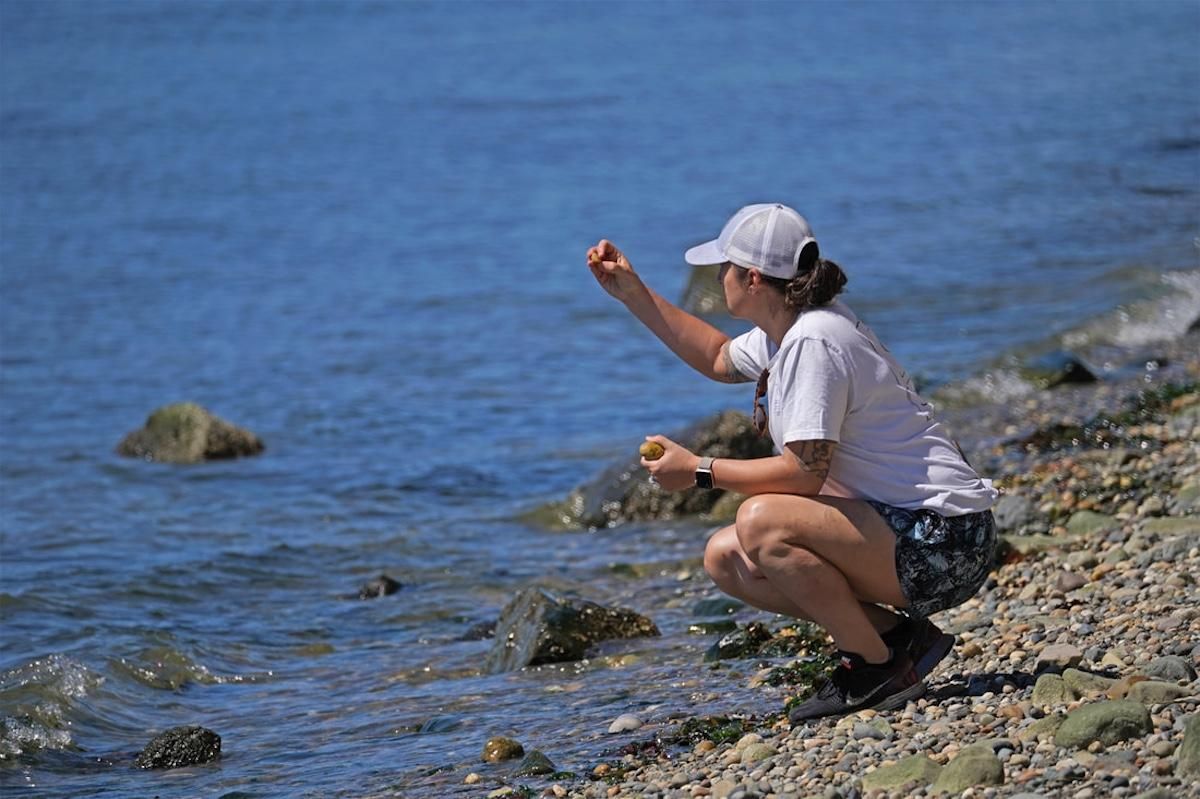
Up ahead, a woman stood in place for a long time, looking down. She was looking for Wishing Rocks, rocks with a band of a different color around them. I asked why, and she said wistfully it reminded her of her late dad, who loved doing that. Farther up the beach we found her husband bent over looking for agates. He showed us one of his beautiful treasures, the sunlight shimmering through with a translucent glow.
At the north end of Kelly’s Point Preserve, Murph rested in the shade of a sand cave, Kath giving him water and treats. We listened to swallows zooming around us feasting on summer bugs, to ravens croaking their stories of the old ways, and to a Swainson’s singing of hope for the future.
What do these creatures think of our explosions and outrageous noises? How do we come into the peace of wild things amid a culture of shock and awe? Places like this show us the stark difference.
The tide was rising as we turned back. Stars of sunlight sparkled in the waves. Boats carved white wakes in the deep blue seas. The bluff cascaded sand and rocks down upon us, reminding us that Yellow Bluff is alive too, in its own way.
At the trailhead, we chose to walk back to the ferry via South Beach Road which has a lot of shade this time of day. Murph was grateful. The ferry was full, carrying many of the people who had crossed over with us nearly three hours earlier.
A wounded veteran also joined us, with life-changing injuries from a long-ago war. And so we come full circle. We remember and honor the sacrifices many have made to give us the freedom to enjoy days like this in places like this.
And we also hold these truths to be self-evident, that our very lives are intertwined with the life and health of our planet. We celebrate life, liberties, and pursuits of happiness for all creatures.
That is worth celebrating! Quietly.
Directions
Directions: take your bike on the Skagit 410 bus or walk or drive to the Guemes Ferry Terminal at 6th Street and I Avenue in Anacortes. Take the ferry to Guemes Island. Walk the beach westward to Kelly's Point, or follow South Shore Drive west to the parking lot where South Shore Drive becomes West Shore Drive. Respect private property, of course.
Mobility: the ferry approach ramps are sloped. The roadways are paved and mostly flat or gently sloped, with minimal traffic. The beach is sandy, rocky, and gravelly, and not passable at the highest of tides.
Republished with permission. Read the original article.